








The Emerald Buddha stands as one of the most revered religious objects in Southeast Asia, enshrined at the heart of Thailand’s spiritual and national identity. Known formally as Phra Kaew Morakot, the Emerald Buddha is not only a symbol of Buddhist faith but also a potent emblem of royal legitimacy and unity. Its remarkable history spans centuries, involving multiple kingdoms, legendary discoveries, and a journey across countries before finding its permanent home in Bangkok. Examining its story reveals the intertwining of religious devotion, political power, and cultural heritage that continues to shape its significance today.
Origins and Discovery of the Emerald Buddha
The origins of the Emerald Buddha are shrouded in legend and historical ambiguity. According to traditional accounts, the Emerald Buddha was created in 43 BCE in the city of Pataliputra, India, by the sage Nagasena. The statue is said to have been crafted with remarkable skill, imbuing it with spiritual power and destined to bring prosperity wherever it resided. However, historical evidence suggests the statue is much younger, likely dating to the 15th century and originating in Southeast Asia, possibly in the Lan Na Kingdom (modern northern Thailand).
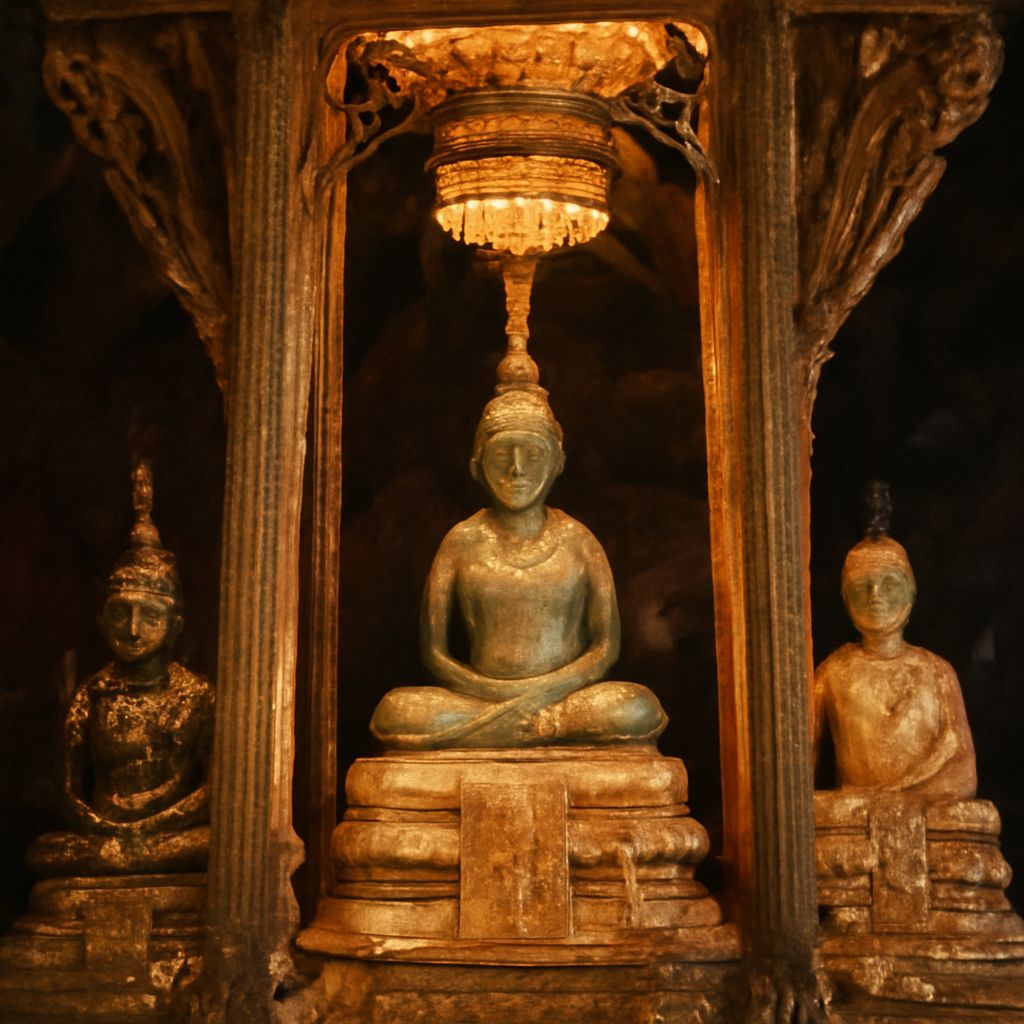
The name “Emerald Buddha” refers not to the gemstone itself but to the rich green color of the statue, which is carved from a single block of jade. The statue stands about 66 centimeters tall and depicts the meditating Buddha in the seated yogic posture known as virasana. Its earliest known discovery occurred in Chiang Rai in 1434, when lightning struck a pagoda at Wat Pa Yia, exposing the statue hidden within a stucco covering. The true nature of the statue was revealed when the outer layer cracked, revealing the gleaming green surface beneath.
From the moment of its discovery, the Emerald Buddha was regarded as a sacred relic, believed to possess extraordinary protective and auspicious powers. Its emergence became the subject of numerous local legends, many of which attribute miraculous events to its presence. These stories helped solidify its place as a central object of veneration, elevating its status far beyond that of an ordinary Buddha image.
Religious and Cultural Significance
The Emerald Buddha is widely considered the palladium of Thailand—an object entrusted with the spiritual well-being and sovereignty of the nation. Its presence is believed to ensure the stability of the country and the prosperity of its people. As the most sacred Buddha image in Thailand, the Emerald Buddha commands deep reverence among Buddhists, and its enshrinement in the Temple of the Emerald Buddha (Wat Phra Kaew) within the Grand Palace complex reinforces its role as a protector of the monarchy and the Thai capital.
Religiously, the Emerald Buddha is closely associated with Theravada Buddhism, the predominant form of Buddhism practiced in Thailand and neighboring countries. Although the statue itself is not worshiped as a deity, it serves as a powerful symbol of the Buddha’s teachings and the moral authority of the Thai monarchy. The tradition of changing the statue’s seasonal robes—performed three times a year by the King of Thailand—underscores the close relationship between religious ritual and royal duty.
Beyond its religious significance, the Emerald Buddha occupies a central position in Thai cultural identity. Its image appears in art, literature, and national iconography, reflecting the intertwined nature of spiritual and political life in Thailand. Major state ceremonies, such as the coronation of a new king or national Buddhist holidays, are conducted in the presence of the Emerald Buddha, reinforcing its role as a unifying emblem for the Thai people.
The statue’s cultural influence extends beyond Thailand’s borders. Various Southeast Asian cultures, particularly in Laos and Cambodia, have legends and traditions related to the Emerald Buddha, reflecting its regional importance as a symbol of Buddhist kingship and national protection. Some legends even suggest the statue once resided in these neighboring lands before its current enshrinement in Bangkok.
The Journey of the Emerald Buddha Through History
From India to Southeast Asia
Legends surrounding the Emerald Buddha recount an epic journey from its purported creation in India, following the spread of Buddhism across Asia. The statue is said to have traveled to Sri Lanka for safekeeping during periods of strife before making its way to Southeast Asia. While there is no historical evidence supporting the Indian or Sri Lankan origin stories, these tales underscore the statue’s perceived sanctity and its association with Buddhist propagation.
The more verifiable history of the Emerald Buddha begins in the 15th century with its arrival in the Lan Na Kingdom. After its discovery in Chiang Rai, the statue was moved to Lampang and later Chiang Mai, where it was venerated by successive kings. Its reputation as a bringer of prosperity and protector of kingdoms made it a sought-after prize among regional rulers.
The Statue’s Arrival in Thailand
The Emerald Buddha’s journey to Thailand followed a period of political upheaval and military conquest. In 1552, the statue was seized by the Laotian King Setthathirath and relocated to Luang Prabang, and then to Vientiane, where it remained for over two centuries. In 1779, during the Thonburi period, Thai forces under General Chao Phraya Chakri (later King Rama I) captured Vientiane and brought the statue to Thonburi, and shortly thereafter to Bangkok.
In 1784, King Rama I enshrined the Emerald Buddha in the newly constructed Wat Phra Kaew within the Grand Palace. This act symbolized the establishment of Bangkok as the new capital and reinforced the legitimacy of the Chakri dynasty. Since then, the statue has remained in the Grand Palace, serving as the guardian of the Thai nation and its rulers. The careful preservation of the statue and its temple highlights the enduring importance of the Emerald Buddha as a touchstone of Thai history and identity.
The Emerald Buddha Today: Location and Rituals
The Emerald Buddha is currently housed in the ordination hall (ubosot) of Wat Phra Kaew, part of the Grand Palace complex in central Bangkok. The temple is considered the most sacred Buddhist site in Thailand, attracting millions of pilgrims and tourists each year. Strict protocols govern the viewing and worship of the Emerald Buddha, reflecting its supreme status among Thai religious icons.
The statue is placed high on a gilded pedestal, out of reach of ordinary visitors, emphasizing its sanctity. Only the reigning King of Thailand is permitted to approach the statue directly. One of the most important rituals associated with the Emerald Buddha is the triannual changing of its robes, which marks the traditional Thai seasons: summer, rainy season, and winter. Each change is performed by the King or his representative and is accompanied by prayers for national protection and well-being.
Wat Phra Kaew is the site of major Buddhist ceremonies, royal events, and state rituals. The Emerald Buddha’s continued presence in the heart of the Thai capital serves as a living testament to the enduring power of faith and tradition in Thai society. As both a religious and national symbol, the Emerald Buddha maintains a vital role in shaping the cultural legacy of Thailand for generations to come.
